Are you an importer or exporter looking to ship hazardous cargo safely? Understanding the IMO class list is your first step to avoid delays, fines, or cargo rejection at Egyptian ports. In this guide, we cover all dangerous goods classes from Class 1 to Class 9, their UN numbers, and proper packaging and stowage practices. Learn how your shipping agent can ensure safe, IMDG Code-compliant transport while protecting your business from maritime risks.
What is the IMDG Code and Its Link to the IMO Class List ?
The IMDG Code (International Maritime Dangerous Goods Code) is the global rulebook that sets out how dangerous goods must be handled during sea transport. Its main goal is to protect ships, crew, and the marine environment from potential hazards.
The code is closely tied to the IMO class list, which divides dangerous goods into nine classes (Class 1–9). Each class has its own rules for packaging, storage, labeling, and documentation. For anyone shipping hazardous materials through Egyptian or international ports, understanding the IMDG Code alongside the IMO class list is the first step to safe and compliant operations.
Scope of the IMDG Code in Global and Egyptian Ports
The IMDG Code applies not only to ships carrying dangerous goods but also to the ports where these goods are loaded, discharged, or stored. In Egypt, ports like Alexandria, Damietta, and Port Said enforce these requirements strictly for all shipments that fall under the IMO class list.
Although its primary focus is maritime transport, the scope of the IMDG Code also extends to related stages such as temporary storage and connected inland transport. This makes it essential knowledge for exporters, importers, and logistics companies handling dangerous cargo.
In Egypt, ports like Alexandria, Damietta, and Port Said enforce these requirements strictly.
(For a full overview of key maritime hubs, check our Egypt Sea Port List.)
International Cooperation Behind the IMDG Code
The IMDG Code was not created by the International Maritime Organization (IMO) alone. It is the result of collaboration with other global bodies such as the International Labour Organization (ILO), the United Nations Economic Commission for Europe (UNECE), and the International Civil Aviation Organization (ICAO). This coordination ensures that the classification and labeling of dangerous goods remain consistent across sea, land, and air.
The code is updated regularly about every two years to reflect new chemical developments and safety practices. For anyone dealing with the IMO class list, keeping up with the latest edition of the IMDG Code is crucial to avoid compliance issues and maintain safe shipping practices.
IMO Class List (1–9) with Subcategories and UN Numbers
The IMO class list divides dangerous goods into nine main classes, with some classes having subcategories (divisions) that describe the specific type of risk. This system, published under the IMDG Code, helps shippers, freight forwarders, and port operators manage dangerous goods safely and in compliance with international regulations.
Class | Subclass | Description | Examples | UN Number |
Class 1 | 1.1 – Mass explosion hazard 1.2 – Projection hazard 1.3 – Fire hazard 1.4 – Minor hazard 1.5 – Very insensitive explosives 1.6 – Extremely insensitive explosives | Explosives and substances with explosive hazard | Dynamite, TNT, Fireworks, Ammunition | UN 0029 (Dynamite), UN 0336 (Fireworks) |
Class 2 | 2.1 – Flammable gases 2.2 – Non-flammable, non-toxic gases 2.3 – Toxic gases | Compressed, liquefied, or dissolved gases | Propane, Oxygen, Chlorine, LPG | UN 1075 (Propane), UN 1005 (Ammonia) |
Class 3 | No subclasses | Flammable liquids | Gasoline, Diesel, Ethanol, Paints | UN 1203 (Gasoline), UN 1170 (Ethanol) |
Class 4 | 4.1 – Flammable solids 4.2 – Substances liable to spontaneous combustion 4.3 – Substances which emit flammable gases in contact with water | Solids that can ignite easily or react dangerously | Matches, Phosphorus, Sodium | UN 1325 (Flammable solid), UN 1408 (Calcium carbide) |
Class 5 | 5.1 – Oxidizing substances 5.2 – Organic peroxides | Oxidizers and organic peroxides that release oxygen and intensify fire | Ammonium nitrate, Hydrogen peroxide | UN 1942 (Ammonium nitrate), UN 2014 (Hydrogen peroxide) |
Class 6 | 6.1 – Toxic substances 6.2 – Infectious substances | Poisonous and infectious materials | Pesticides, Cyanide, Medical waste, Viruses | UN 2810 (Toxic liquid), UN 3291 (Medical waste) |
Class 7 | No subclasses | Radioactive materials | Uranium, Plutonium, Radioactive isotopes | UN 2912 (Radioactive material) |
Class 8 | No subclasses | Corrosive substances | Sulfuric acid, Hydrochloric acid, Battery acid | UN 1830 (Sulfuric acid), UN 1789 (Hydrochloric acid) |
Class 9 | No subclasses | Miscellaneous dangerous substances | Dry ice, Lithium batteries, Asbestos | UN 3480 (Lithium batteries), UN 1845 (Dry ice) |
Global Harmonized System (GHS) and Its Connection to the IMO Dangerous Goods List
The Globally Harmonized System (GHS) is the worldwide framework for classifying and labeling chemicals. Its goal is to use one unified system of symbols and hazard categories so that workers, shippers, and customs authorities can understand risks instantly no matter the country.
The IMDG Code builds on this by applying GHS rules specifically to maritime transport. Together, they ensure that the IMO class list and the IMO dangerous goods list are recognized internationally, with clear labels, UN numbers, and consistent safety rules across sea, land, and air.
Hazard Labels and Placards for IMO Class Dangerous Goods
When it comes to the IMO class dangerous goods system, labels and placards are the frontline tools for communication.
- Labels → Small hazard signs placed directly on packages (e.g., a box of IMO Class 3 flammable liquids).
- Placards → Larger hazard signs displayed on shipping containers or tankers, visible from a distance at ports and during transport.
Both use the same international design colors, pictograms, and numbers so that anyone can recognize the risk. For example, a red diamond with a flame (Class 3) instantly signals a flammable liquid, while a black-and-white skull (Class 6.1) warns of toxic cargo.
Types of Labels and Symbols Used for IMO Class Cargo
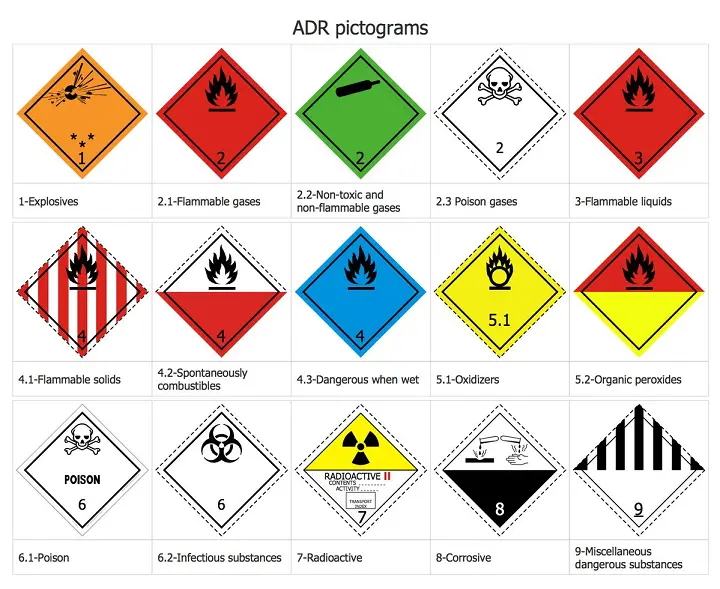
Every IMO class has a specific label design, helping crews and inspectors quickly identify the type of hazard:
- Class 1 (Explosives): Orange label with a bursting ball symbol.
- Class 2 (Gases): Red (flammable), green (non-flammable), or white (toxic) cylinders.
- Class 3 (Flammable Liquids): Red diamond with flame.
- Class 7 (Radioactive): Yellow and white with the radiation trefoil symbol.
- Class 9 (Miscellaneous Dangerous Goods): Black and white stripes, often used for lithium batteries.
These standardized IMO class labels, paired with the correct UN number, make dangerous goods easier to recognize and handle safely at sea.
Packaging and Stowage of Dangerous Goods in Maritime Transport
The IMDG Code requires strict rules for packaging, stowage, and segregation of dangerous goods on ships.
- Packaging Groups (PG I, II, III): Define the degree of danger (I = high danger, III = low danger). For example, IMO Class 1 cargo may need PG I packaging for maximum protection.
- Stowage on vessels: Dangerous goods must be placed in specific areas of the ship, often away from heat sources, food, or incompatible chemicals.
- Common violations:
- Using damaged or uncertified containers.
- Mixing incompatible classes (e.g., oxidizers near flammable liquids).
- Missing or incorrect hazard labels.
Proper packaging and stowage not only comply with the IMO dangerous goods list but also protect crew, port workers, and the marine environment.
Restrictions and Acceptance of IMO Class Dangerous Goods in Egyptian Ports
Not all dangerous goods listed in the IMO class list are accepted freely at Egyptian ports. Regulations differ depending on the cargo’s class, risk level, and destination:
- Completely prohibited categories: Some explosives (IMO Class 1 cargo) and radioactive materials are restricted due to high safety risks.
- Conditional acceptance: Flammable liquids (IMO Class 3) or miscellaneous dangerous substances (IMO Class 9) may be accepted only under strict documentation and packaging requirements.
- Port differences: For example, Alexandria may apply stricter controls on chemicals compared to Damietta or Port Said, reflecting local safety infrastructure.
This makes it essential for shippers to check the IMO dangerous goods list alongside specific Egyptian port regulations before planning a shipment.
Costs and Fees for Shipping Cargo Under the IMO Class List in Egypt
Transporting cargo classified under the IMO class list in Egypt involves additional charges:
- Egyptian port fees: Hazardous cargo handling fees are applied based on IMO class UN number and Packaging Group.
- Carrier surcharges: Shipping lines often add premiums for IMO Class 1 cargo (explosives) or IMO Class 3 cargo (flammable liquids).
- Cost factors: Total cost depends on volume, risk level, packaging requirements, and any special stowage needs onboard.
Understanding these variables helps traders budget accurately and avoid surprise costs.
Transporting cargo classified under the IMO class list in Egypt involves additional charges (Still, many businesses choose sea freight for its cost-effectiveness — see our guide on the 5 Advantages of Sea Transport.)
Classification Codes for Dangerous Goods
Dangerous goods are identified using standardized codes that complement the IMO class list:
- UN Numbers: A four-digit code (e.g., UN 1203 for gasoline) that identifies each hazardous material globally.
- Packaging Groups (PG I, II, III): Indicate the level of danger (high, medium, low).
- Documentation: Both the IMO dangerous goods list and classification codes are required on the bill of lading, safety data sheet (SDS), and port declarations.
This coding system ensures consistency in safety across international shipping.
Practical Steps for Shipping IMO Class Dangerous Goods in Egypt
Shippers must follow a structured process when handling IMO class dangerous goods:
- Identify the Class: Match the cargo against the IMO class list (Class 1–9).
- Check SDS: Review the Safety Data Sheet for handling and hazards.
- Confirm UN Number: Ensure the correct UN identification and Packaging Group.
- Obtain Carrier Approval: Get acceptance from the shipping line.
- Notify Port Authorities: Submit required documents before cargo arrival.
This checklist minimizes delays and ensures compliance with both IMDG Code and Egyptian laws.
Validity of the Dangerous Goods Certificate
The Dangerous Goods (DG) Certificate is essential for anyone handling cargo from the IMO class list. In Egypt:
- Validity period: Typically valid for 2 years from the date of issuance.
- Renewal required: Training must be refreshed before expiry, especially for staff handling IMO Class 3 or IMO Class 9 shipments.
Regular renewals ensure that workers stay updated with the latest IMDG Code amendments.
Alignment of the IMO Dangerous Goods List with MARPOL, SOLAS, and Incoterms
The IMO class list does not operate in isolation. It aligns with:
- MARPOL: Prevents marine pollution from hazardous cargo.
- SOLAS: Ensures ship and crew safety during stowage and transport.
- Incoterms: Define responsibilities between buyer and seller when dealing with dangerous cargo.
This interconnected framework guarantees that IMO class dangerous goods are handled safely from port to port.
The IMO class list does not operate in isolation. It aligns with MARPOL, SOLAS, and Incoterms… (To better understand port functions, read our article on the Difference Between Dry Port and Sea Port.)
Is your cargo classified under IMO Dangerous Goods (Class 1–9)? Don’t worry!
With our company, you get safe and IMDG Code compliant sea freight solutions through major Egyptian ports like Alexandria, Damietta, and Port Said. We support you with:
- Preparing accurate Dangerous Goods Declarations (DGD).
- Proper packaging, labeling, and documentation according to UN Numbers.
- Coordinating with carriers and port authorities to prevent delays or cargo rejection.
Whether you are an importer or exporter, our expert team ensures your hazardous cargo is shipped securely, on time, and in full compliance with international regulations.
Choose us for smarter, safer, and hassle-free sea freight of IMO Class cargo.
Ready to ship your IMO cargo safely?
Request a Shipping Quote today and let our experts handle the rest!
FAQ
What Are Common Mistakes in Handling IMO Class Cargo?
Errors in handling IMO class dangerous goods can be costly:
- Incorrect UN number: Leads to cargo rejection.
- Misdeclared Class (e.g., flammable liquid as non-hazardous): Risk of fines or legal action.
- Improper packaging: Can result in accidents, environmental damage, and delays.
Financial consequences include penalties, demurrage fees, and loss of reputation with shipping lines.
Why You Need a Dangerous Goods Declaration (DGD)
The Dangerous Goods Declaration (DGD) is not optional it is a critical safety document:
- Ensures compliance: Confirms the cargo matches the IMO dangerous goods list and corrects UN code.
- Protects all parties: Provides vital handling information to carriers, ports, and emergency services.
- Legal requirement: Without a DGD, cargo may be rejected, fined, or even confiscated.
This declaration builds trust and reduces risks in the shipping process.
Who Is Responsible for Classifying IMO Dangerous Goods?
Responsibility for classification under the IMO class list is shared:
- Shipper/Supplier: Must correctly declare the cargo class and UN number.
- Carrier/Shipping line: Verifies documents and ensures stowage is compliant.
- Port Authorities: Final oversight for acceptance and handling.
Under the IMDG Code, the shipper holds the primary legal responsibility for accurate classification.
How to Obtain a Dangerous Goods License in Egypt
Companies wishing to handle cargo from the IMO dangerous goods list need an official license. Steps include:
- Authorized bodies: Approval from the Egyptian Maritime Transport Authority and Ministry of Transport.
- Requirements: Qualified staff with valid Dangerous Goods Certificates, compliant storage facilities, and safety procedures.
- Process: Submit application, undergo inspection, and secure approval for handling or transporting IMO class dangerous goods.
This ensures that only competent operators manage high-risk shipments.
IMO class list