Understanding ocean freight container dimensions is the first step to mastering global shipping efficiency. Whether you’re an Egyptian importer sending goods to Dubai or a local exporter managing heavy machinery through Alexandria Port, the right container choice can make or break your shipment. This guide reveals how container sizes, international standards, and port logistics directly impact cost, safety, and speed with real examples from Egypt’s trade routes. Let’s explore how smart container planning transforms your shipping success.

What You Need to Know About Ocean Freight Container Dimensions
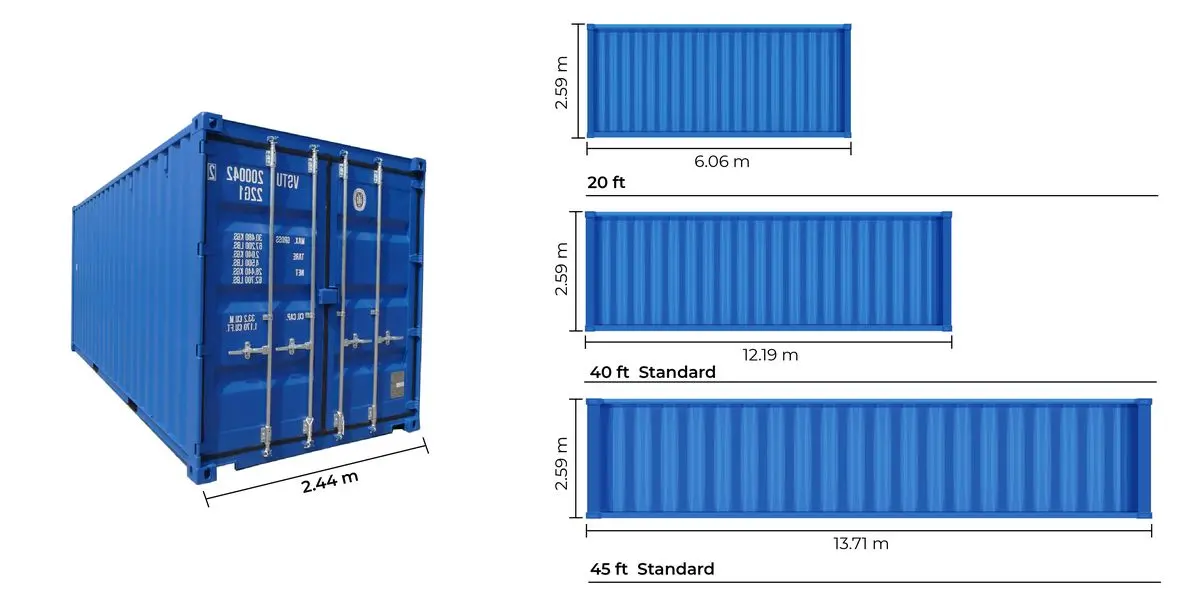
When it comes to international shipping, understanding ocean freight container dimensions is essential for any business or freight forwarder in Egypt managing exports and imports worldwide. A shipping container is a standardized metal box designed to store and transport goods safely across sea routes. It plays a key role in the global logistics chain, ensuring efficient loading, unloading, and stacking at ports.
There are two sets of measurements for every container:
- External dimensions define the overall size of the container and determine how many units can fit on a vessel or truck.
- Internal dimensions refer to the usable cargo space available for goods inside the container.
All containers follow ISO standards, which ensure uniformity and compatibility across global shipping lines.
Practical Example:
In Egypt, a 20 ft container is commonly used for shipping household goods or dry food items to destinations like Dubai or Rotterdam. These containers balance cost efficiency and storage capacity, making them ideal for small to medium exporters. By understanding shipping container sizes in meters and their internal capacity, Egyptian shippers can optimize load planning, reduce empty space, and improve overall freight efficiency. A solid grasp of these container measurements also supports smoother Cargo Loading and Unloading Procedure in Ships, ensuring safer and faster operations at Egyptian ports.
Top 4 ocean freight container dimensions Used in Global Trade
Exploring various types of containers helps businesses match the right solution to their cargo. Whether it’s general goods, temperature-sensitive products, oversized machinery, or liquid materials, each container type offers unique features to support safe and efficient global transport.
1- Dry Cargo Containers
The dry cargo containers , commonly called a general-purpose container, are the most versatile type of container. It is suitable for transporting a wide range of goods, from non-perishable items to industrial equipment. These containers are equipped with lashing devices installed on longitudinal rails and corner posts to secure the cargo during transit. For heavier or bulkier goods, the High Cube container provides additional height, while Hardtop containers are designed to accommodate cargo that exceeds standard height limits.
Container Type:20 DC Container
Length | width | height |
5.9M | 2.35M | 2.40M |
Maximum Load:28000 KGS
Container Type:40 HQ Container
Length | Width | Height |
12M | 2.35M | 2.59M |
Maximum Load:28000 KGS
Container Type:45 HQ Container
Length | Width | Height |
13.6M | 2.35M | 2.65M |
Maximum Load:29000 KGS
2- Reefer Containers
Reefer containers are specialized shipping containers used for temperature-sensitive goods. These containers are equipped with refrigeration systems to maintain precise temperature conditions during transportation, making them ideal for perishable items like fruits, vegetables, dairy products, and meat. By preserving the shelf life of such goods, reefer containers ensure they reach their destination in optimal condition.
Container Type:20 RF Container
Length | Width | Height |
5.90M | 2.35M | 2.40M |
Maximum Load:26000 KGS
Container Type:40 RF Container
Length | Width | Height |
12M | 2.35M | 2.59M |
Maximum Load:29000 KGS
3-Special Equipment
Specialized containers, such as open-top containers, cater to unique cargo requirements. The open-top container allows for the entire roof to be removed, facilitating the loading of over-height goods that cannot fit through the standard container door. This makes it suitable for transporting large machinery, bulky goods, or any cargo requiring loading assistance from cranes or rolling bridges.
Container Type: 20 FT Container
Length | Width | Height |
5.9M | 2.35M | 2.25M |
Maximum Load:28000 KGS
Container Type: 40 FT Container
Length | Width | Height |
12M | 2.35M | 2.25M |
Maximum Load:28000 KGS
Container Type:20 OT Container
Length | Width | Height |
5.9M | 2.35M | 2.40M |
Maximum Load:28000 KGS
Container Type:40 OT Container
Length | Width | Height |
12M | 2.35M | 2.40M |
Maximum Load:28000 KGS
4-ISO Tank Container
ISO tank containers are designed to meet the International Organization for Standardization (ISO) standards. Constructed from stainless steel and layered with protective coatings, these containers are the safest and most efficient choice for transporting liquids, gases, and hazardous chemicals. Their robust construction ensures that even sensitive or dangerous substances can be transported securely over long distances.
Maximum Load:34000 KGS
How to Choose the Right Ocean Freight Container Dimensions for Your Shipment
Selecting the right container is not random it’s a calculated process that depends on your cargo’s size, weight, nature, port infrastructure, and total cost. Understanding ocean freight container dimensions helps Egyptian traders make accurate shipping decisions and avoid costly mistakes.
Follow these practical steps before booking your container:
- Measure your cargo carefully – Record length, width, and height, then calculate the total CBM. Example: a box measuring 1.2 × 0.8 × 0.6 m equals 0.576 m³.
- Check total weight – Ensure your goods do not exceed the load limit for 20 ft container dimensions in meters or larger containers. Heavy goods like steel may require splitting into multiple units.
- Match cargo type with container size – If your load fills around 70% of capacity, a smaller unit may save cost. For taller or bulkier items, opt for a 40ft container dimensions or High Cube option.
- Assess port and road capabilities – Confirm that Egyptian ports such as Alexandria or Damietta can handle container types and sizes you plan to use, including lifting capacity and road clearance.
- Review extra costs and compliance – Specialized containers or refrigerated units add fees, and you must ensure each meets shipping container sizes and prices standards and ISO certifications.
For smooth international shipping, always ask your local freight agent for the official specification sheet of your container — this guarantees your cargo moves efficiently and complies with Egyptian port regulations. These steps form the foundation of an efficient sea export freight forwarding process, helping Egyptian shippers streamline customs, port handling, and vessel scheduling.
How Ocean Freight Container Dimensions Affect Logistics in Egypt
Even if you select the perfect container on paper, Egypt’s logistics infrastructure can introduce additional challenges that affect overall freight efficiency. Understanding how ocean freight container dimensions interact with local port conditions helps importers and exporters avoid costly surprises.
Key factors to consider before finalizing your shipment:
- Port depth and terminal design – Some Egyptian ports, like Alexandria, have draft limits of around 14 meters, restricting access for larger vessels or certain container types and sizes.
- Crane and equipment capacity – Older terminals may not handle extra-tall or heavy containers, such as High Cube or 40ft container dimensions, efficiently.
- Handling and storage fees – Additional charges may apply for containers requiring special lifting gear or extended unloading time.
- Customs and transport limits – Local authorities enforce strict truck weight limits when transporting shipping container sizes in meters within the port area, especially for dense or heavy cargo.
- Road and yard restrictions – Narrow truck lanes or low bridges near Alexandria and Damietta ports can restrict oversized ocean freight container sizes, leading to routing delays.
When signing contracts with your freight forwarder or carrier in Egypt, include a clause confirming that the selected container complies with local port standards. This simple step can prevent costly container swaps, demurrage fees, or penalties at customs. Despite logistical limits, sea freight remains the backbone of global trade. Understanding the 5 advantages of sea transport including cost efficiency, capacity, global reach, sustainability, and safety helps businesses in Egypt make informed choices when shipping internationally. These strengths make sea transport the preferred option for long-distance and heavy cargo.
Real-World Applications of Ocean Freight Container Dimensions in Egypt
To truly understand how ocean freight container dimensions affect your shipment, let’s break down realistic examples that mirror actual operations in Egypt’s import and export market. These scenarios show how dimensions, capacity, and weight limits translate into real logistical choices.
Example 1 – Furniture Shipment from Cairo to Jebel Ali (UAE)
You’re exporting home furniture for four rooms: sofas, wardrobes, tables, and chairs.
- Total Volume: 60 m³
- Total Weight: 3,500 kg
Options: - 40ft Standard Container: capacity ≈ 67 m³
- 40ft High Cube: capacity ≈ 76 m³
If the furniture items are standard height, the 40ft Standard fits perfectly and offers lower freight cost.
However, if your shipment includes tall wardrobes or stacked items, a High Cube (9’6” high instead of 8’6”) prevents damage and makes loading easier — especially when using forklifts at Alexandria Port.
Tip: High Cube containers may cost slightly more, but they minimize risk of breakage and reduce wasted air space inside.
Example 2 – Heavy Machinery Import via Damietta Port
You’re importing industrial pumps and engine blocks for a factory project.
- Total Volume: 28 m³
- Total Weight: 24,000 kg
Even though the volume fits easily in a 20 ft container, the weight exceeds its safe payload limit (≈ 21,700 kg).
The best choice is to split the cargo into two 20 ft containers to comply with port crane limits and road transport restrictions in Egypt.
Tip: Egyptian customs and port cranes often have stricter lifting rules than some foreign ports — always confirm the shipping container sizes and prices with your local freight forwarder before loading abroad.
Example 3 – Mixed Consumer Goods to Alexandria
You’re importing a mixed cargo: electronics, packaged foods, and small appliances from China.
- Total Volume: 58 m³
- Total Weight: 16,500 kg
The challenge here is space utilization, not weight. Your logistics agent provides a container dimensions in cm spec sheet to optimize stacking.
Using a 40ft High Cube allows double-stacking cartons safely without exceeding the 30,480 kg gross weight limit.
Tip: For mixed cargo, it’s not about filling every inch but achieving stable packing density and balanced weight distribution — key for smooth customs inspection in Egyptian ports.
These examples show how analyzing container types and sizes before booking helps Egyptian importers and exporters avoid delays, extra fees, and poor space usage — ensuring every shipment moves efficiently from warehouse to vessel. Choosing the right container also depends on the types of vessels in shipping, since vessel size and deck configuration directly influence loading capacity and cost efficiency.
Flexible Sea Freight Services with the Right Ocean Freight Container Sizes
Looking for trusted Ocean freight services that combine speed, safety, and cost efficiency? At ACS Logistics Co. , we provide tailored shipping solutions for every cargo type — from general goods to sensitive or oversized shipments. With our wide network, advanced types of containers , and dedicated support team, we make global trade simpler and more reliable. Choose ACS Logistics Co. and let your business grow with seamless ocean shipping.
Request a shipping quote today and let our experts handle the rest.
FAQs
What’s the difference between a standard shipping container and a high cube?
The main difference lies in the height. Both have the same length and width, but a high cube container is usually about 30 cm taller than a standard one. This extra space allows businesses to load larger or more lightweight goods without increasing shipping weight, making high cubes a smart choice for bulky or high-volume cargo.
Is a 20ft shipping container as tall as a 40ft shipping container?
Yes — when comparing standard containers, both the 20ft and 40ft sizes share the same height (around 2.59 meters / 8.5 feet). However, if you’re using high cube containers, the height increases to 2.89 meters / 9.5 feet, providing additional storage capacity.
What Is the Capacity of an Ocean Freight Container
A 20ft container typically holds about 33 cubic meters, while a 40ft container offers roughly 67 cubic meters. High cube versions add around 10% more volume, giving shippers extra flexibility for light but bulky goods. Exact capacity may vary slightly depending on manufacturer and design.
What Fits in a 20ft and 40ft Ocean Freight Container?
A 20ft container can usually fit furniture from a 2–3 bedroom apartment, small machinery, or around 25–28 pallets. A 40ft container doubles that space, ideal for large commercial loads or 50–55 pallets. High cube containers are often chosen for taller items like stacked cartons, vehicles, or equipment.
What Are the Common Uses of 10ft, 20ft, and 40ft Standard Ocean Freight Containers?
- 10ft containers: Small shipments, personal storage, or samples for trade fairs.
- 20ft containers: Standard for medium-size exports and imports used by Egyptian SMEs for machinery, furniture, and packaged goods.
- 40ft containers: Ideal for full-scale exports, including textiles, consumer goods, and heavy industrial equipment.
Choosing the right container size helps you control costs and ensures efficient global shipping through Egypt’s major ports.
Ocean Freight Container Dimensions Guide 2025 |Sizes & Types